
The IIT JAM (Joint Admission Test for Master’s) is one of the most competitive entrance exams in India for students aiming to pursue MSc, MSc-PhD, and other postgraduate science programs at IITs, IISc, NITs, and other prestigious institutes. Every year, thousands of aspirants appear for this exam, but only those with a clear understanding of the question types, difficulty level, and exam structure manage to secure a good rank.
If you are preparing for IIT JAM, one of the most common questions in your mind is:
“What type of questions are asked in IIT JAM?”
This blog will answer that in detail, in a simple and exam-oriented manner.
Overview of IIT JAM Question Paper
Before understanding the types of questions, it is important to know the overall structure of the IIT JAM paper.
Key Highlights of IIT JAM Exam
- Mode of exam: Online (Computer-Based Test)
- Duration: 3 hours
- Total marks: 100
- Medium: English only
- Number of sections: 3
- Negative marking: Applicable (for some sections)
A clear understanding of the exam pattern helps candidates plan their preparation smartly and avoid unnecessary mistakes during the exam.
Sections in IIT JAM Question Paper
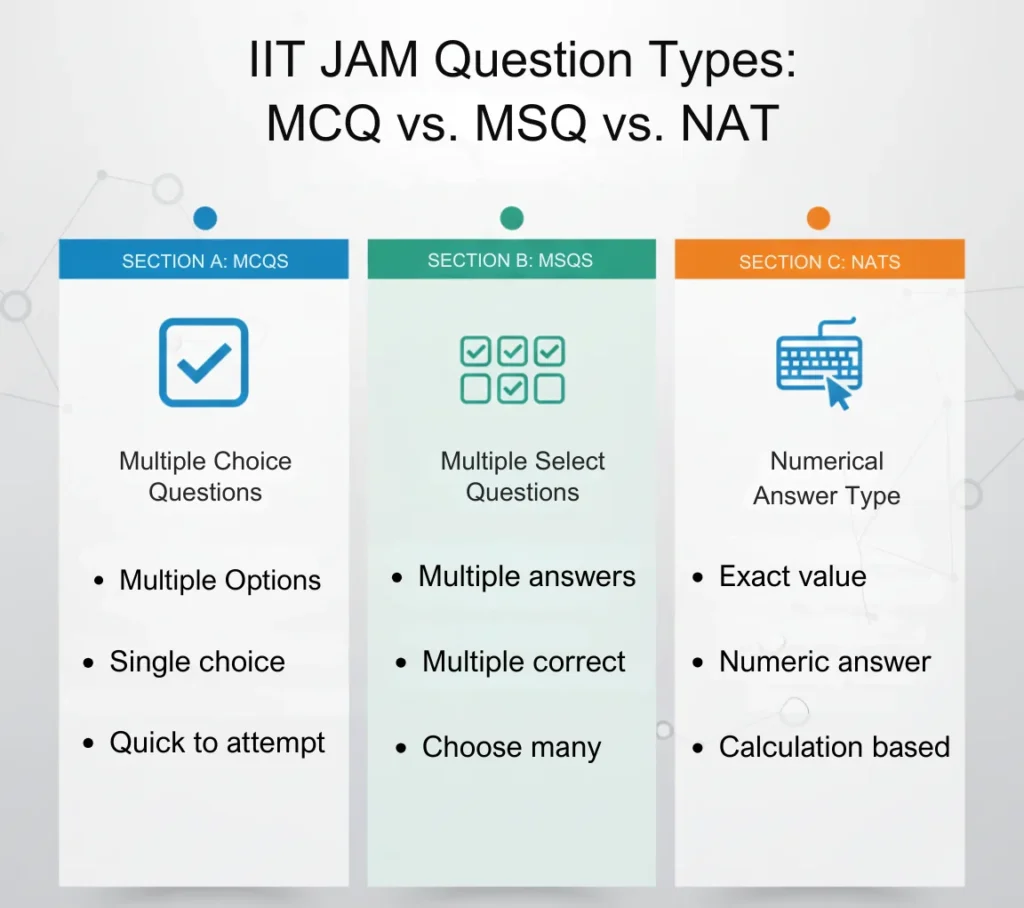
The IIT JAM question paper is divided into three sections, each testing a different skill set.
Section A: Multiple Choice Questions (MCQs)
This section tests your conceptual clarity and accuracy.
Features of MCQs:
- Four options are given
- Only one correct answer
- Negative marking is applicable
- Questions can be factual, conceptual, or numerical
Marking scheme:
- 1 mark questions: −⅓ negative marking
- 2 mark questions: −⅔ negative marking
What is usually asked?
- Direct concept-based questions
- Formula application
- Theory-based problems
- Simple numerical calculations
Section B: Multiple Select Questions (MSQs)
This section is slightly more challenging and tests the depth of understanding.
Features of MSQs:
- One or more options may be correct
- No negative marking
- Partial marking is not allowed
What is usually asked?
- Concept-linking questions
- Analytical thinking
- Elimination-based logic
- Multiple correct statements
MSQs require careful reading, as missing even one correct option can result in zero marks.
Section C: Numerical Answer Type (NAT)
This section focuses on problem-solving ability.
Features of NAT:
- No options are given
- Answer must be typed using a virtual keypad
- No negative marking
What is usually asked?
- Numerical problems
- Calculation-based questions
- Formula-driven answers
- Accurate rounding and precision
Subject-Wise Nature of Questions in IIT JAM
The type of questions varies slightly depending on the subject you choose, such as Life Sciences, Physics, Chemistry, Mathematics, Biotechnology, Economics, or Geology. However, the overall approach remains similar.
Life Sciences (Most Popular Paper)
For Life Sciences aspirants, questions are asked from:
- Cell Biology
- Molecular Biology
- Genetics
- Biochemistry
- Ecology
- Evolution
- Physiology
- Developmental Biology
Nature of questions:
- Conceptual and application-based
- Diagram-oriented understanding
- Experimental logic questions
- Assertion-reason type logic (in MCQs/MSQs)
This is where structured guidance from platforms like calsnetexam (Catalyst Academy of Life Science) becomes extremely helpful, as they focus on concept clarity rather than rote learning.
Difficulty Level of IIT JAM Questions
One of the biggest myths is that IIT JAM questions are extremely tough. In reality, the difficulty level can be classified as:
- Easy to Moderate: 30–40%
- Moderate: 40–50%
- Moderate to Difficult: 10–20%
Most questions are concept-based, not memorization-based. If your fundamentals are strong, you can score well.
Conceptual vs Numerical Questions
IIT JAM is known for balancing both theory and numericals.
Conceptual Questions
- Test understanding of basic principles
- Often appear in MCQs and MSQs
- Require clarity, not mugging
Numerical Questions
- Mostly in the NAT section
- Require correct formula application
- Accuracy matters more than speed
Good Study material plays a crucial role in mastering both types, especially material that includes topic-wise practice questions and previous year analysis.
Importance of Previous Year Questions
One of the smartest ways to understand what type of questions are asked in IIT JAM is by analyzing previous year papers.
Benefits:
- Understand repeated concepts
- Identify high-weightage topics
- Learn exam temperament
- Improve time management
Institutes like Calsnetexam (Catalyst Academy of Life Science) focus heavily on PYQs and pattern analysis, which helps students align their preparation with real exam demands.

Common Mistakes Students Make
While preparing for IIT JAM, many students make avoidable mistakes:
- Ignoring MSQs due to fear of multiple answers
- Not practicing NAT questions enough
- Relying only on theory without problem-solving
- Not revising concepts regularly
- Studying without understanding the exam pattern
Avoiding these mistakes can significantly improve your score.
Role of Coaching in IIT JAM Preparation
Self-study is important, but structured guidance can accelerate your preparation.
A good IIT JAM Coaching provides:
- Topic-wise conceptual clarity
- Expert faculty guidance
- Mock tests aligned with the actual exam
- Doubt-solving sessions
- Proper revision strategy
calsnetexam (Catalyst Academy of Life Science) offers online coaching specifically designed for Life Sciences aspirants, focusing on concept building, practice, and exam-oriented preparation.
How to Prepare for Different Question Types
For MCQs
- Focus on fundamentals
- Practice elimination techniques
- Revise formulas regularly
For MSQs
- Read questions carefully
- Understand statement-based logic
- Practice multi-concept questions
For NATs
- Practice calculations daily
- Improve numerical accuracy
- Learn shortcut methods wisely
Final Preparation Tips for IIT JAM
- Start early and plan monthly targets
- Revise weak areas multiple times
- Solve mock tests regularly
- Analyze mistakes after every test
- Use reliable Study material only
- Stay consistent and confident
Conclusion
To crack the IIT JAM, it is essential to clearly understand what type of questions are asked in the IIT JAM. The exam tests conceptual clarity, analytical ability, and numerical accuracy rather than rote memorization. By understanding MCQs, MSQs, and NATs, analyzing previous year papers, and following a structured preparation plan, you can significantly improve your performance.
With the right guidance from platforms like calsnetexam (Catalyst Academy of Life Science) and a strong focus on concepts, clearing IIT JAM becomes an achievable goal.
FAQ
Q1. What type of questions are asked in IIT JAM?
IIT JAM includes MCQs, MSQs, and Numerical Answer Type (NAT) questions that test conceptual understanding and problem-solving skills.
Q2. Is there negative marking in IIT JAM?
Yes, negative marking applies only to MCQs. MSQs and NAT questions have no negative marking.
Q3. Are IIT JAM questions concept-based?
Yes, most questions are conceptual and application-oriented, not based on rote learning.
Q4. Which section is the most scoring in IIT JAM?
The NAT section is the most scoring due to no negative marking.
Q5. Is coaching necessary for IIT JAM preparation?