

Is MSc Physics Worth It? Benefits, Jobs, and Future Prospects
Choosing a postgraduate path is a major decision — especially in a field as vast and advanced as Physics. With rapid developments in quantum computing, semiconductor fabrication, photonics, nuclear sciences, astrophysics, and climate research, students often ask:
“Is an MSc in Physics really worth it?”
This blog provides a complete, easy-to-understand breakdown covering course details, career paths, salaries, future scope, and how to make your MSc degree truly pay off. We’ve also included insights useful for students choosing m sc physics online classes for flexible learning.
What an MSc in Physics Actually Covers
An MSc Physics program develops deep scientific and analytical skills required in research, high-tech industries, data science, and academia. Whether you study offline or through m sc physics online classes, the curriculum remains highly rigorous.
Core Subjects You Study
You will learn advanced concepts such as:
- Quantum Mechanics
- Statistical Mechanics
- Electrodynamics
- Nuclear & Particle Physics
- Condensed Matter Physics
- Electronics & Instrumentation
- Mathematical Physics
- Advanced Laboratory Techniques
These subjects help you build strong theoretical and practical foundations.
Research Component
Most MSc Physics programs include hands-on research, often through:
- A thesis or project
- Laboratory experiments
- Computer simulations & modelling
- Research paper presentations
This research exposure is essential for PhD and R&D roles.
Key Transferable Skills You Gain
Physics graduates develop highly valuable skills like:
- Mathematical modelling
- Analytical problem-solving
- Programming (Python, MATLAB, C++)
- Data interpretation & simulation
- Critical thinking
- Technical/scientific writing
These skills are recognized globally across scientific and corporate industries.
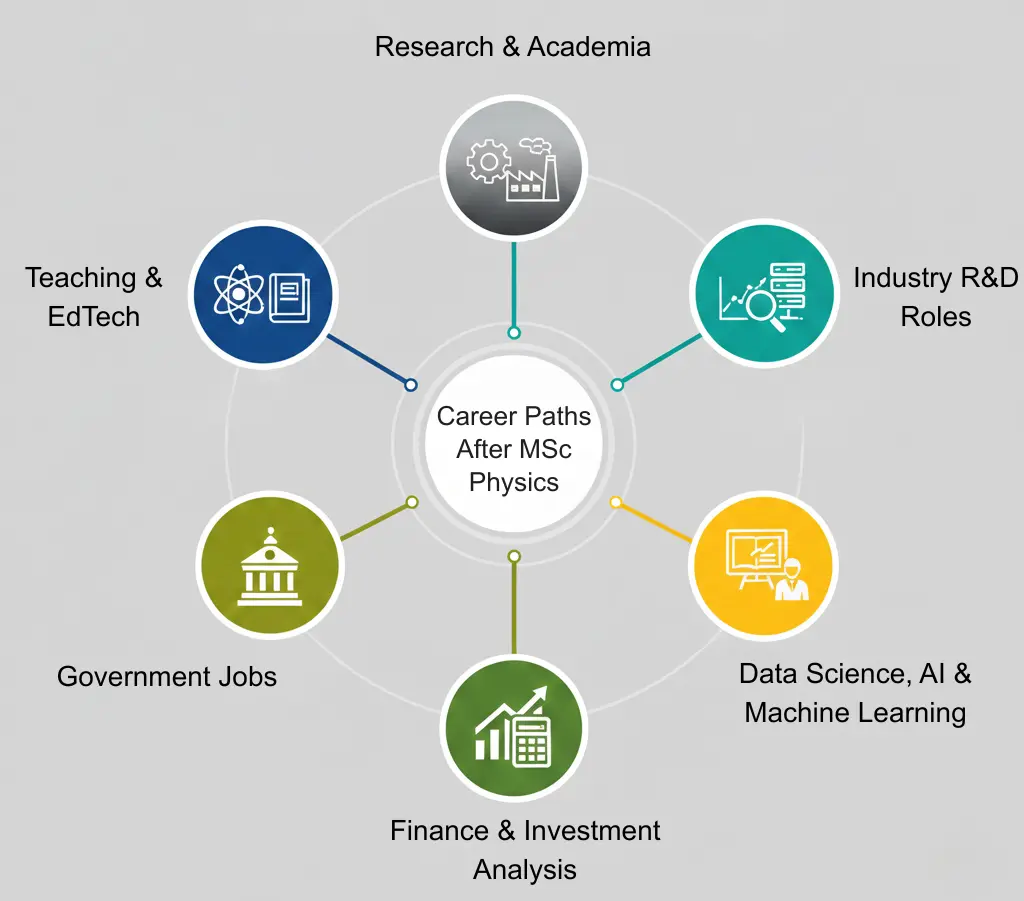
Career Paths After MSc Physics
One of the biggest advantages of this degree is the diversity of career opportunities it unlocks.
1. Research & Academia
Ideal for students who want to pursue:
- PhD (in India or abroad)
- Research fellowships
- Scientist positions
Popular organizations include:
ISRO, DRDO, BARC, IISc, TIFR, IITs, NASA-affiliated labs, and international universities.
2. Industry R&D Roles
Industries that regularly hire physicists:
- Semiconductors
- Optics & Photonics
- Nanotechnology
- Renewable Energy
- Medical Imaging & Devices
- Aerospace & Defense
Job roles:
R&D Engineer, Optical Scientist, Lab Physicist, Quality Control Specialist.
3. Data Science, AI & Machine Learning
Physics students transition smoothly into tech roles due to strong math + coding skills.
Possible roles:
- Data Analyst
- Machine Learning Engineer
- Quantitative Researcher
- Business Analyst
This path offers some of the highest-paying opportunities after an MSc.
4. Finance & Investment Analysis
Physics graduates are valued in finance for their numerical skills.
Roles include:
- Quant Analyst
- Risk Analyst
- Market Researcher
5. Government Jobs
Government sectors that hire MSc Physics graduates:
- Meteorology (IMD)
- Defense Labs (DRDO, LRDE)
- ISRO research assistant roles
- PSU technical positions
- SSC & UPSC science-related roles
6. Teaching & EdTech
Perfect for students who enjoy teaching:
- Assistant Professor
- Physics Tutor
- EdTech Content Creator
- Online Physics Instructor for m sc physics online classes
Salary After MSc Physics — What to Expect
Salary varies depending on job role, skills, and specialization.
Average Salary Ranges
Career Path Entry-Level Salary (Approx.)
Research & Academia ₹3–6 LPA
Industry R&D ₹4–8 LPA
Data Science / ML ₹6–12 LPA
Semiconductor/Photonics ₹5–10 LPA
Government Jobs ₹4–7 LPA
Teaching ₹3–6 LPA
Mid-career salaries in tech and research labs can reach ₹12–25 LPA or more.
When Is MSc Physics NOT the Right Choice?
You may want to reconsider if:
- You expect very high salaries immediately
- You dislike math-intensive subjects
- You prefer managerial or non-technical roles
- You don’t enjoy research work
- You’re unwilling to learn coding or analytical tools
If these apply, explore alternatives like MSc Data Science, MTech, or MBA.
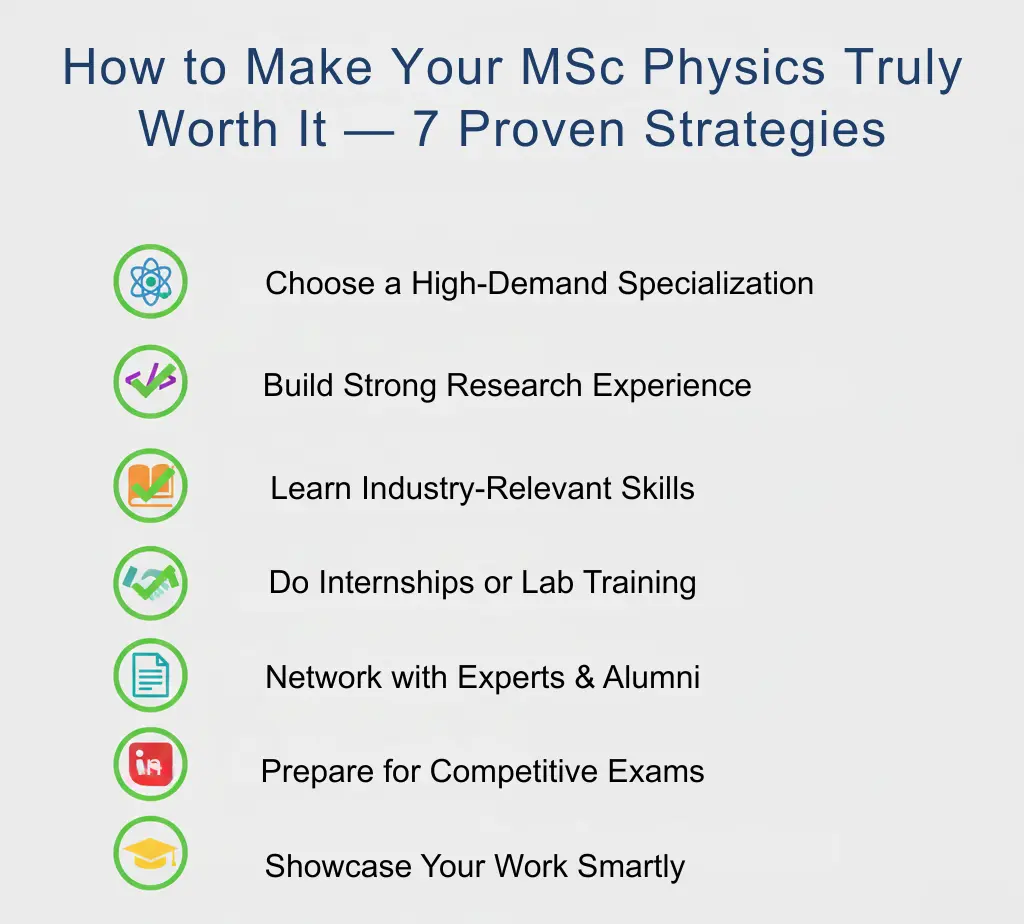
How to Make Your MSc Physics Truly Worth It — 7 Proven Strategies
To maximize your career growth and ROI:
- Choose a specialization (quantum, photonics, semiconductor physics).
- Learn programming languages like Python, MATLAB, and C++.
- Take electives in high-demand areas.
- Join internships or short-term research projects.
- Publish papers or present at conferences.
- Build a strong LinkedIn & GitHub portfolio.
- Prepare early for PhD or industry certifications.
These steps significantly improve job outcomes, even if you study via m sc physics online classes.
Alternatives to MSc Physics
Different programs may suit different career goals:
1. MTech (Engineering Pathway)
Ideal for engineering-heavy industries.
2. MSc Data Science / AI
Best for analytics, ML, and tech-driven careers.
3. MBA After BSc Physics
Great for management careers and business roles.
4. Industry Skill Certification Courses
Short courses in:
- Electronics
- Optics
- Semiconductors
- Embedded Systems
- Artificial Intelligence
Future Scope of MSc Physics
The demand for physicists is growing with global investments in emerging technologies.
High-Growth Sectors
- Quantum Computing
- Semiconductor Fabrication
- Optics & Photonics
- Space Technology
- Climate Science
- Nuclear Research
- Nanotechnology
These sectors offer high-paying roles and long-term stability.
Real-Life Success Stories (Mini Profiles)
1. Physics Graduate → Data Scientist
Used Python, statistics, and modeling skills to secure a Data Science job within a year.
2. MSc Physics → Optical Engineer
Joined a photonics company after hands-on lab projects and an internship.
3. MSc → Funded PhD Abroad
Secured a PhD position in Europe through publications and a strong research background.
How to Choose the Right MSc Physics Program
Important questions to ask before selecting a university:
- Do they offer specializations?
- Are lab facilities modern and research-focused?
- Does the faculty support your area of interest?
- Do they have industry/research collaborations?
- What are placement and PhD outcomes?
Choosing the right institute greatly influences career success.
Conclusion — Is MSc Physics Worth It for You?
Yes — MSc Physics is absolutely worth it if you enjoy scientific problem-solving, research, and want a long-term career in high-tech industries, data science, or academia. It offers global opportunities, strong salaries, and intellectual growth.
With the right strategy, practical projects, coding skills, and possibly m sc physics online classes, this degree becomes one of the most rewarding STEM paths available.
FAQs About MSc Physics
1. Is MSc Physics worth it in 2025?
Yes, especially for careers in research, tech, and data science.
2. Can I get a good job after MSc Physics?
Absolutely — especially in semiconductor, photonics, and data-driven industries.
3. What is the salary after MSc Physics?
Entry-level salaries range from ₹3–12 LPA.
4. Can I switch to Data Science?
Yes, Physics students are excellent candidates due to math + coding skills.
5. Can I go abroad after MSc Physics?
Yes, many countries offer fully funded PhD opportunities.